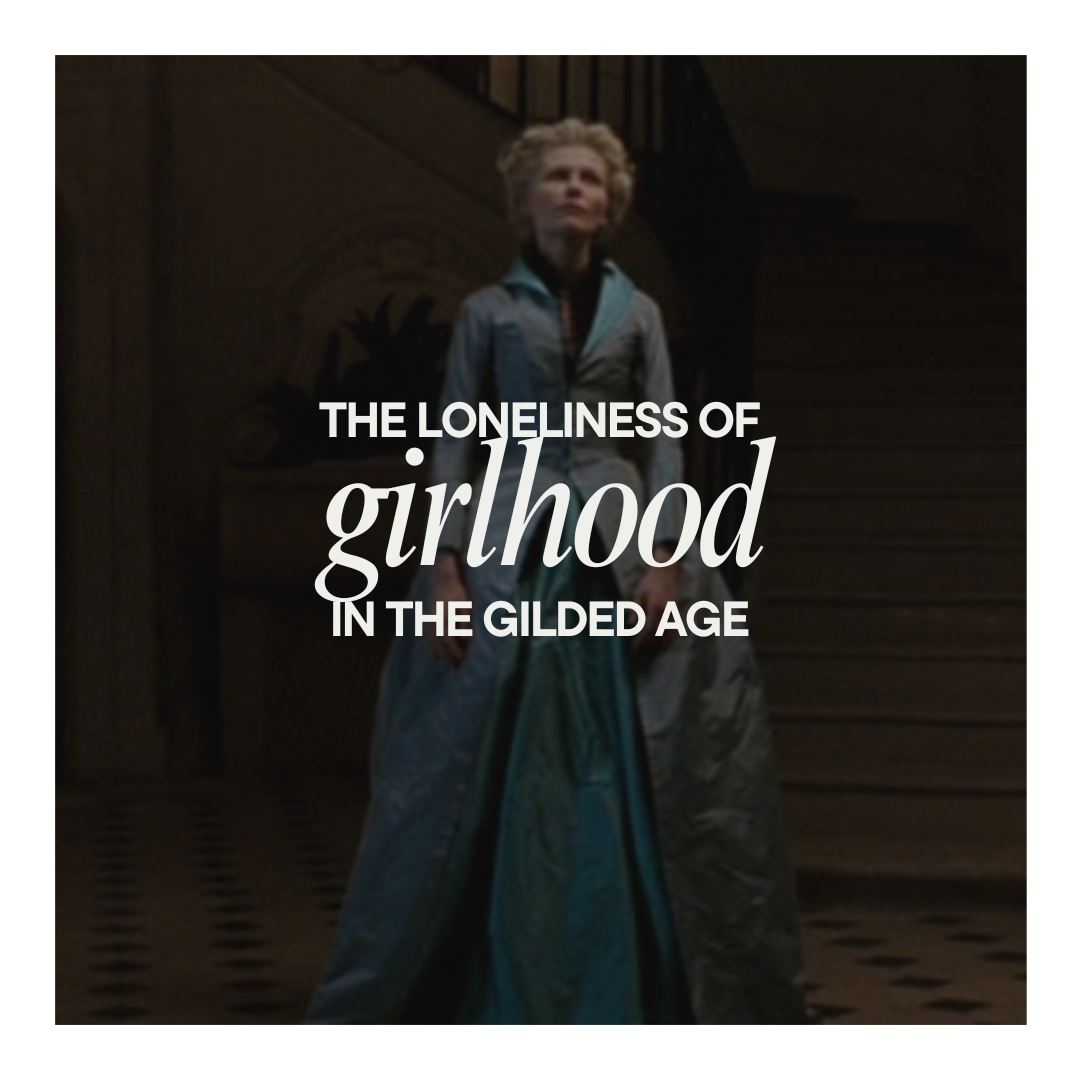
Going into Marie Antoinette (2006), you expect to see powdered wigs, political drama and some sort of dramatic retelling of the French Revolution war but dressed up in bright color grading and a girls dream. Instead of an accurate period drama, you’re given pastel desserts, indie rock, and a teenage girl who looks like she’d rather be doing anything else. It’s soft, pretty, indulegent and quietly killing Marie’s girlhood.
At the center of it all is Kirsten Dunst, playing Marie Antoinette not as a historical villain, but as something familiar: a girl trying to survive in a world that has already decided who she is. Once you realize this, it hits kind of harder. Undernearth the overconsumption and beauitful colors isn’t a story that is completely about royalty… it’s about girlhood, isolation and what happens when you’re forced to perform a version of yourself before you know who you are.

Marie feels and is young. Before becoming queen or becoming a symbol, she’s a teenage girl sent to France from Austria like a political package. Her mother even tells her that this is needed to keep the countries friendship. She doesn’t get to make the choice. She doesn’t have a moment to reflect and decide if that’s what she wants. Her destiney has already been decided and she is actively moving towards it.
From the beginning, she is watched, evaluated and controlled. Her body, marriage and ability to produce an heir do not belong to her. She is the property of everyone in France before she is herself. It’s overwhelming, absurd and suffocating. How can we expect Marie to grow into herself as a woman when she is always placed in front of an audiance? When every action is politicized, judged and observed?

Versailles is stunning. Soft golds and endless gardens; it’s a place that belongs in a dream. But the longer you sit with it, or in Marie’s case live in it, the more it starts to feel like a beautiful cage.
Sofia Coppola makes this contract clear. The palace is filled with light and color, but Marie herself often feels small within it. She’s surrounded by people but has no real connection. Conversations are shallow, relationships are transactional and intimacy is almost nonexistent.
This kind of lonliness doesn’t look like loneliness from the outside. She has everything anyone has ever dreamed of — money, status, beauty – but none of it is emotional fulfillment. Her life is the epitomie of “moeny doesn’t buy happiness.” This forces you to confront the idea of external perfection and the how it doesn’t equal internal happiness.

So what does the girl who has everything do to numb the pain of loniliness? She finds an escape.
Not physically, but emotionally. Parties, fashion, gambiling and overconsumption. The stunning montage of shoes, cakes and champagne isn’t only because it’s pretty. She found a way to cope, be distracted and feel something other than the pressure cooker that she currently sits in.
The film doesn’t frame her indulgence as soley selfish or irresponsibe, which it is. Rather, it feels as though Marie is desperate. It feels like she is clinging to anything that makes her feel alive.
It’s hard not to see the paralleles between Marie and influencers in current day. Using consumption and aesthetics to fill a void that seems to last forever. Even as the movie approaches 20, the message is still relevant in 2026.

Marie Antoninette’s experience is painful as she spends most of her days and night performing for those around her. She is uniquiely her, but also desperate to fit in. Desperate to be loved. She’s not living her life for herself, rather she is constantly performing for an unamused audiance.
Every interaction, outfit, and rumor becomes part of her public identity. Once that identity is established it is nearly impossible to change. Just how some Hollywood actors are known for being difficult to work with and now have a hard time finding work, struggle to remove the identity that they created for themselves. Marie is labeled frivolous, excessive, our of touch and no matter what she does, that label sticks.
Marie doesn’t get the chance to define herself. She is defined by the court, public and history. And the more she tries to assert any sense of individuality, the more she’s critizied for it.

An interesting artistic choice was that the film didn’t explicitly explain anything. There wasn’t any heavy exposition, no dramatic speeches laying out everything. Instead, a lot of the story is told through visuals, music and mood.
The use of modern music like The Stokes creates a weird but effective bridge between the past and present. It’s a reminder that despite the historical setting, the emotions are contemporary. The anxiety, isolation and desire to connect are all current.
Then there is silence. Moment’s where Marie is just exisiting. Sitting, staring, waiting. Those moments are familiar because it strips away the spectale and leaves you with something raw: a girl who doesn’t know who she is or how to be okay in a life she didn’t choose.

Historically, Marie Antoinette hasn’t been portrayed… well… kindly. She’s often reduced to a caricature of excess and indifference, summed up by the infamous (and inaccurate) “let them eat cake” quote.
This film doesn’t try to argue that she was perfect. Instead it questions what if she were just… human.
What is her mistakes came from immaturatiyy rather than malice? What if her indulgence was a response to isolation rather than greed? What if she was just a young girl placed in an impossible situation that she was forced into rather than the villan.
It doesn’t excuse her actions and two things can be true at once, but it further complicate her as a character. In doing so, it challenges the audiance to reconsider narratives we accept without question.

A film like Marie Antoinette can linger with some because of how relevant is it. Maybe not in a literal sense but in an emotional sense.
As a teenage girl, there is a pressure to perform and a ffear of being misunderstood. The loneliness that comes even when you’re surrounded by people. The tendancy to look for escapes in aesthetics, substances or attention when reality is overwhelming.
Maybe the film resonates so deeply with women because of this. It taps into something that doesn’t really change across time: the experience of trying to find yourself in a world that keeys telling you who you’re supposed to be.

Marie Antoinette isn’t a traditional historical drama and it doesn’t need to be. It’s soft, quiet and more introspective. It trades political drama for emotional truth, and in doing so, it creates something that feels surprisingly intimate.
It’s easy to get caught up in the beautoful visuals: the dress, the colors, the beauty of it all. But underneath that is a story about loneliness, idendity and the cost of being seen but not understood.
At its core, it isn’t just a movie about a queen. It’s a story about a girl forced to grow up too soon.


Leave a Reply